


Bioinformatics: What It Is, and How Medical Laboratory Specialists Can Move Into It
Bioinformatics is biology done with data. Here is what it means, why it matters to medical labs, and how laboratory specialists can build a career in it.
Bioinformatics is one of the fastest-growing frontiers in modern health science — and it sits exactly where medical laboratory specialists already stand: at the meeting point of biology, technology, and patient care. So what does it actually mean, why does it matter now, and how can someone with a lab background move into this field?
This article answers those three questions in plain language.
What Is Bioinformatics?
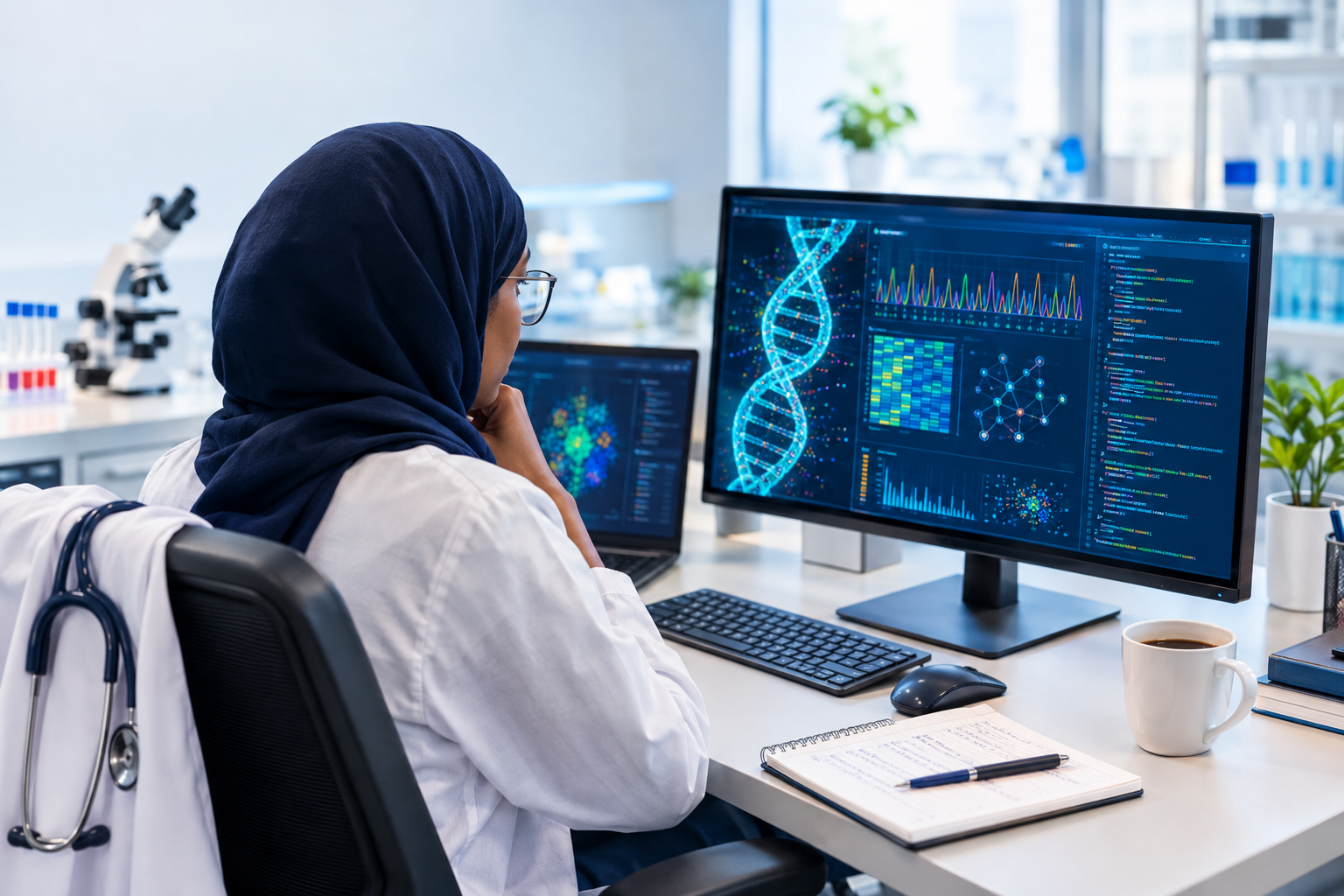
Bioinformatics is the use of computers, software, and statistics to store, analyse, and make sense of biological data — especially the huge amounts of data coming from DNA, RNA, proteins, and other molecules. When we sequence a genome, run a molecular panel, or study a pathogen, we generate enormous datasets that no human can read by eye. Bioinformatics is the discipline that turns that raw data into meaning.
Why It Matters for Medical Laboratories
Traditional laboratory work focuses on a single measurement: a glucose value, a culture result, a blood count. Modern molecular and genomic testing produces thousands or millions of data points per sample. This is where bioinformatics becomes essential — and where lab professionals have a genuine advantage.
- ✔Genomic and molecular testing is now routine in many labs — and it generates data that must be interpreted, not just reported
- ✔Quality control, method validation, and reference-range studies increasingly rely on data analysis
- ✔Outbreak tracking, antimicrobial-resistance surveillance, and public-health labs run on data
- ✔Laboratory information systems, electronic records, and dashboards all need people who understand both the lab and the data
- ✔The next generation of diagnostics is computational — and someone has to design and run it
What a Bioinformatics Professional Actually Does
| Area | What It Involves |
|---|---|
| Data analysis | Processes and interprets sequencing, molecular, and laboratory datasets |
| Pipeline building | Creates automated workflows that take raw data through cleaning, alignment, and reporting |
| Variant interpretation | Connects genetic variants to clinical meaning, using curated databases and literature |
| Data quality | Checks accuracy, reproducibility, and reliability of results before they reach a clinician |
| Integration | Links laboratory systems, databases, and reporting tools so data flows safely and clearly |
| Research support | Helps design studies, analyse outcomes, and answer clinical questions with evidence |
How Medical Laboratory Specialists Can Transform
You do not need to start over or abandon your medical knowledge. In fact, your laboratory background is the rarest and most valuable part of the transition — many bioinformaticians understand the data but not the disease, the sample, or the patient. You already understand all three. What you add is the computational layer.
- ✔Start with your existing foundation — your knowledge of biochemistry, haematology, immunology, and molecular biology is the hardest part for others to learn
- ✔Learn one programming language well — Python and R are the working languages of the field; Python is the friendliest starting point
- ✔Get comfortable with biological data tools — sequence formats, databases such as NCBI/Ensembl, and standard analysis toolkits
- ✔Study the essentials of statistics — even a solid working understanding of probability, variation, and hypothesis testing opens many doors
- ✔Build real projects, not just certificates — analyse a public dataset, build a small pipeline, publish your code on GitHub
- ✔Bridge both worlds in your current job — volunteer for the laboratory data, quality, or information-system tasks wherever you work
- ✔Consider a structured qualification — a postgraduate certificate, master's, or recognised online specialisation adds credibility and depth
Career Opportunities in the Field
Bioinformatics is not a single job — it is a family of roles, and medical laboratory specialists are well placed for the clinical-facing ones in particular.
| Role | Where It Fits |
|---|---|
| Clinical Bioinformatics | Supports diagnosis in hospitals and reference laboratories; variant and results interpretation |
| Genomics / Molecular Laboratory | Runs and interprets sequencing and molecular panels; often a lab-scientist role with a computational core |
| Research Bioinformatics | Universities and institutes; study design, data analysis, and publication |
| Public Health & Surveillance | National labs and health agencies; outbreak tracking, resistance monitoring, population data |
| Pharmaceutical & Biotech | Drug discovery, clinical trials, biomarker development, regulatory data |
| Health Data / Informatics | Hospital systems, laboratory information systems, digital health platforms, dashboards |
| Teaching & Training | Universities and training programmes; a growing need in our region and worldwide |
| Freelance / Consulting | Analysis services for laboratories, clinics, and research groups that need expertise without a full-time hire |
Skills That Carry You Farthest
- ✔Biological understanding — the ability to know when a result makes scientific sense is a genuine superpower
- ✔Programming — Python (and increasingly R) for analysis, automation, and reproducible work
- ✔Data literacy — databases, data cleaning, visualisation, and honest reporting
- ✔Statistics — knowing the difference between a real signal and noise
- ✔Communication — explaining a computational result to a clinician in clinical language
- ✔Curiosity and self-teaching — the field changes fast; the habit of learning is the real qualification
Common Misconceptions
| Misconception | Reality |
|---|---|
| “I need to be a computer scientist first.” | You do not. A medical or biological foundation plus focused computing skills is a strong, in-demand combination. |
| “Bioinformatics is only for researchers.” | Clinical and laboratory bioinformatics is now part of routine diagnostic practice in many hospitals. |
| “It is too late to change direction.” | Most people enter this field from another background — the transition is the norm, not the exception. |
| “The lab knowledge I have won't be used.” | The opposite. It is the part that lets you judge whether a computational result is clinically believable. |
A Final Word
Bioinformatics is not a departure from medical laboratory science — it is an extension of it. The sample still needs to be collected and validated; the result still needs to be interpreted and explained. What changes is the scale and the tools. For a laboratory specialist willing to add the computational layer, this is one of the most natural and rewarding transitions in modern healthcare.
Found this helpful? Share it with colleagues, or connect with me on LinkedIn for more lab medicine and bioinformatics content.
Dr. Mohammad Sulieman — Medical Laboratory Specialist & Academic Lecturer
Comments
Comments are moderated
❤️ Likes are instant for everyone! 💬 Comments are reviewed by our team before being published. Please use only letters, numbers, and basic punctuation.
No comments yet. Be the first to share your thoughts!
Mohammad Sulieman Ibrahim
Full Stack Developer & Writer
Bioinformatics: What It Is, and How Medical Laboratory Specialists Can Move Into It
By Mohammad Sulieman
https://medblog.seeha.tech/posts/bioinformatics-what-it-is-and-how-medical-lab-specialists-can-move-into-it
Scan to read online
Bioinformatics is one of the fastest-growing frontiers in modern health science — and it sits exactly where medical laboratory specialists already stand: at the meeting point of biology, technology, and patient care. So what does it actually mean, why does it matter now, and how can someone with a lab background move into this field?
This article answers those three questions in plain language.
What Is Bioinformatics?
Bioinformatics is the use of computers, software, and statistics to store, analyse, and make sense of biological data — especially the huge amounts of data coming from DNA, RNA, proteins, and other molecules. When we sequence a genome, run a molecular panel, or study a pathogen, we generate enormous datasets that no human can read by eye. Bioinformatics is the discipline that turns that raw data into meaning.
Why It Matters for Medical Laboratories
Traditional laboratory work focuses on a single measurement: a glucose value, a culture result, a blood count. Modern molecular and genomic testing produces thousands or millions of data points per sample. This is where bioinformatics becomes essential — and where lab professionals have a genuine advantage.
- ✔Genomic and molecular testing is now routine in many labs — and it generates data that must be interpreted, not just reported
- ✔Quality control, method validation, and reference-range studies increasingly rely on data analysis
- ✔Outbreak tracking, antimicrobial-resistance surveillance, and public-health labs run on data
- ✔Laboratory information systems, electronic records, and dashboards all need people who understand both the lab and the data
- ✔The next generation of diagnostics is computational — and someone has to design and run it
What a Bioinformatics Professional Actually Does
| Area | What It Involves |
|---|---|
| Data analysis | Processes and interprets sequencing, molecular, and laboratory datasets |
| Pipeline building | Creates automated workflows that take raw data through cleaning, alignment, and reporting |
| Variant interpretation | Connects genetic variants to clinical meaning, using curated databases and literature |
| Data quality | Checks accuracy, reproducibility, and reliability of results before they reach a clinician |
| Integration | Links laboratory systems, databases, and reporting tools so data flows safely and clearly |
| Research support | Helps design studies, analyse outcomes, and answer clinical questions with evidence |
How Medical Laboratory Specialists Can Transform
You do not need to start over or abandon your medical knowledge. In fact, your laboratory background is the rarest and most valuable part of the transition — many bioinformaticians understand the data but not the disease, the sample, or the patient. You already understand all three. What you add is the computational layer.
- ✔Start with your existing foundation — your knowledge of biochemistry, haematology, immunology, and molecular biology is the hardest part for others to learn
- ✔Learn one programming language well — Python and R are the working languages of the field; Python is the friendliest starting point
- ✔Get comfortable with biological data tools — sequence formats, databases such as NCBI/Ensembl, and standard analysis toolkits
- ✔Study the essentials of statistics — even a solid working understanding of probability, variation, and hypothesis testing opens many doors
- ✔Build real projects, not just certificates — analyse a public dataset, build a small pipeline, publish your code on GitHub
- ✔Bridge both worlds in your current job — volunteer for the laboratory data, quality, or information-system tasks wherever you work
- ✔Consider a structured qualification — a postgraduate certificate, master's, or recognised online specialisation adds credibility and depth
Career Opportunities in the Field
Bioinformatics is not a single job — it is a family of roles, and medical laboratory specialists are well placed for the clinical-facing ones in particular.
| Role | Where It Fits |
|---|---|
| Clinical Bioinformatics | Supports diagnosis in hospitals and reference laboratories; variant and results interpretation |
| Genomics / Molecular Laboratory | Runs and interprets sequencing and molecular panels; often a lab-scientist role with a computational core |
| Research Bioinformatics | Universities and institutes; study design, data analysis, and publication |
| Public Health & Surveillance | National labs and health agencies; outbreak tracking, resistance monitoring, population data |
| Pharmaceutical & Biotech | Drug discovery, clinical trials, biomarker development, regulatory data |
| Health Data / Informatics | Hospital systems, laboratory information systems, digital health platforms, dashboards |
| Teaching & Training | Universities and training programmes; a growing need in our region and worldwide |
| Freelance / Consulting | Analysis services for laboratories, clinics, and research groups that need expertise without a full-time hire |
Skills That Carry You Farthest
- ✔Biological understanding — the ability to know when a result makes scientific sense is a genuine superpower
- ✔Programming — Python (and increasingly R) for analysis, automation, and reproducible work
- ✔Data literacy — databases, data cleaning, visualisation, and honest reporting
- ✔Statistics — knowing the difference between a real signal and noise
- ✔Communication — explaining a computational result to a clinician in clinical language
- ✔Curiosity and self-teaching — the field changes fast; the habit of learning is the real qualification
Common Misconceptions
| Misconception | Reality |
|---|---|
| “I need to be a computer scientist first.” | You do not. A medical or biological foundation plus focused computing skills is a strong, in-demand combination. |
| “Bioinformatics is only for researchers.” | Clinical and laboratory bioinformatics is now part of routine diagnostic practice in many hospitals. |
| “It is too late to change direction.” | Most people enter this field from another background — the transition is the norm, not the exception. |
| “The lab knowledge I have won't be used.” | The opposite. It is the part that lets you judge whether a computational result is clinically believable. |
A Final Word
Bioinformatics is not a departure from medical laboratory science — it is an extension of it. The sample still needs to be collected and validated; the result still needs to be interpreted and explained. What changes is the scale and the tools. For a laboratory specialist willing to add the computational layer, this is one of the most natural and rewarding transitions in modern healthcare.
Found this helpful? Share it with colleagues, or connect with me on LinkedIn for more lab medicine and bioinformatics content.
Dr. Mohammad Sulieman — Medical Laboratory Specialist & Academic Lecturer
Did you find this helpful?
I am Mohammad Sulieman, a Full Stack Developer & Writer. Let's connect and build something amazing together.